Mount Olympus
The highest mountain in Greece became the imagined seat of the Olympian gods. In poetry, it marks the distance between divine life and human struggle.
Some mythic places are tied to real landscapes and sanctuaries; others belong to an imagined cosmos. Separating the two helps us see how people used place to remember, worship, and tell stories.
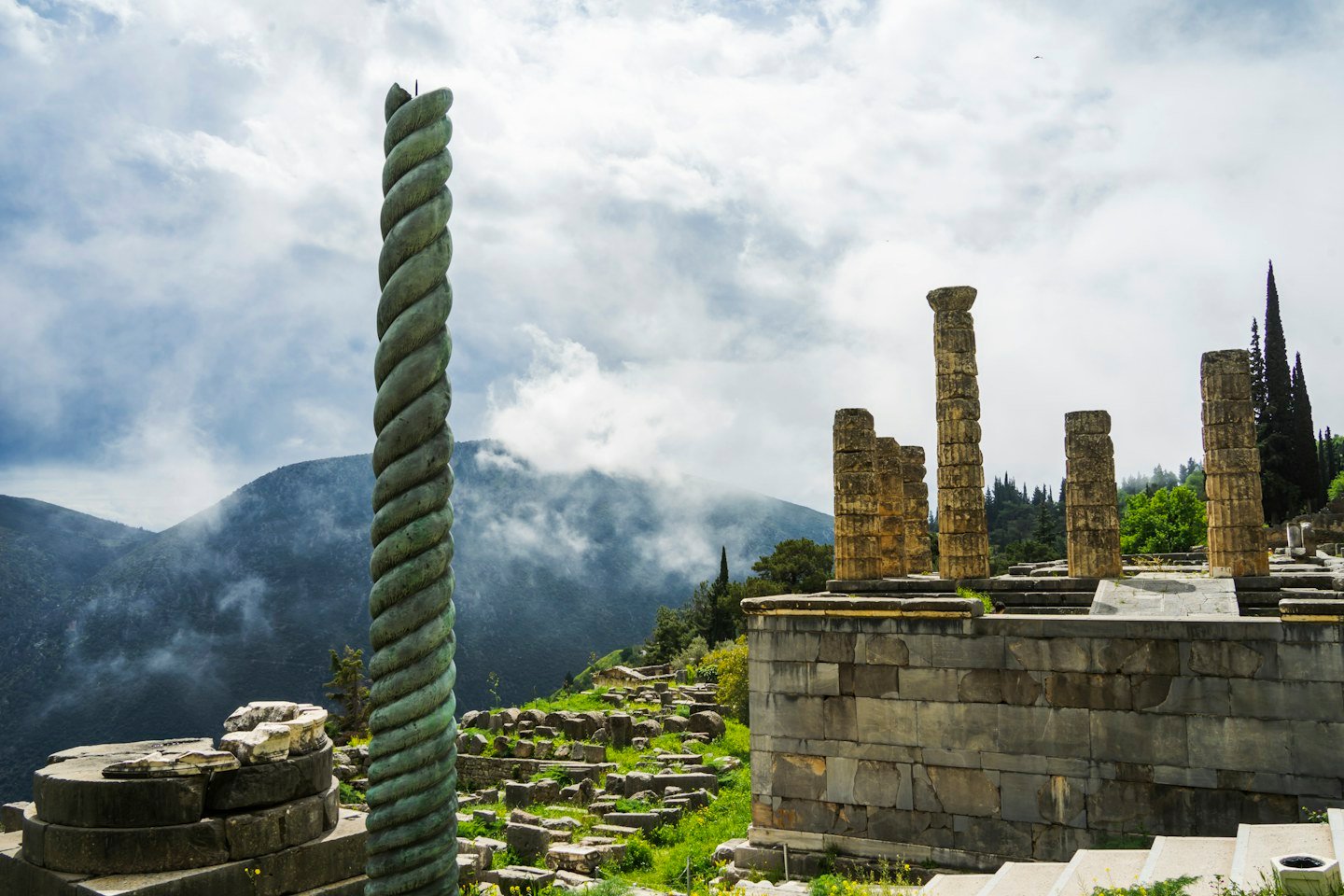
Mount Olympus is a real mountain in northern Greece and, in many Greek stories, the home of the Olympian gods. Delphi was a real sanctuary where people consulted Apollo’s oracle. The underworld, by contrast, is a mythic realm described through poetic images rather than a place that can be mapped like a town.
Stories often anchor invisible powers to a named mountain, spring, cave, or road. Visiting the landscape can enrich our understanding, but the archaeological remains and the later story traditions are different kinds of evidence.
Each place gives a story a different scale: divine, civic, domestic, or beyond the limits of ordinary life.
The highest mountain in Greece became the imagined seat of the Olympian gods. In poetry, it marks the distance between divine life and human struggle.
The sanctuary of Apollo at Delphi drew visitors seeking guidance from the oracle. Its historical remains sit within a striking mountain landscape.
Built to contain the Minotaur in the Cretan cycle, the maze turns architecture into a problem of memory, power, and escape.
Hades can refer to the god and to the realm of the dead. Ancient Greek accounts describe that realm in several ways rather than as one single map.